ASPECT
A Scientific Paradigm for the Efficient Classification of Technology

portability | autonomy | maturity | motivity
The ASPECT framework classifies technology across portability, maturity, autonomy, and motivity. It gives projects a shared vocabulary for describing capabilities and requirements.
The same classifications apply to automation, AI and machine learning, and classical software.
Tip
Components
Primary attributes
Expand an attribute to see its levels.
📦 Portability
- Limited (level 0)
- Source (level 1)
- Containerized (level 2)
- Installer (level 3)
- Package manager (level 4)
- WebAssembly (level 5)
🪴 Maturity
- Unvalidated (level 0)
- Discovery (level 1)
- Concept (level 2)
- Development (level 3)
- Prototype (level 4)
- Proven (level 5)
🤝 Autonomy
- Manual (level 0)
- Machine-assisted (level 1)
- Human-as-primary (level 2)
- Machine-as-primary (level 3)
- Human-supervised (level 4)
- Machine-only (level 5)
🦾 Motivity
- Inert (level 0)
- Computational (level 1)
- Perceptive (level 2)
- Projective (level 3)
- Reactive (level 4)
- Adaptive (level 5)
Data
Data is recorded separately from the four primary attributes.
Its dimensions include:
- Real or synthetic
- Availability
- Modality
- Quality
Example
The following fictional project shows how four levels form one ASPECT classification.
| Attribute | Level | Details |
|---|---|---|
| 📦 Portability | Level 1 | Source |
| 🪴 Maturity | Level 3 | Development |
| 🤝 Autonomy | Level 1 | Machine-assisted |
| 🦾 Motivity | Level 2 | Perceptive |
Badge visualization
An ASPECT badge gives project portfolios a compact view of the four attribute levels.

ASPECT badge for a project
The annotated version identifies the position of each attribute. The same badge can be used in dashboards, reports, and presentations.
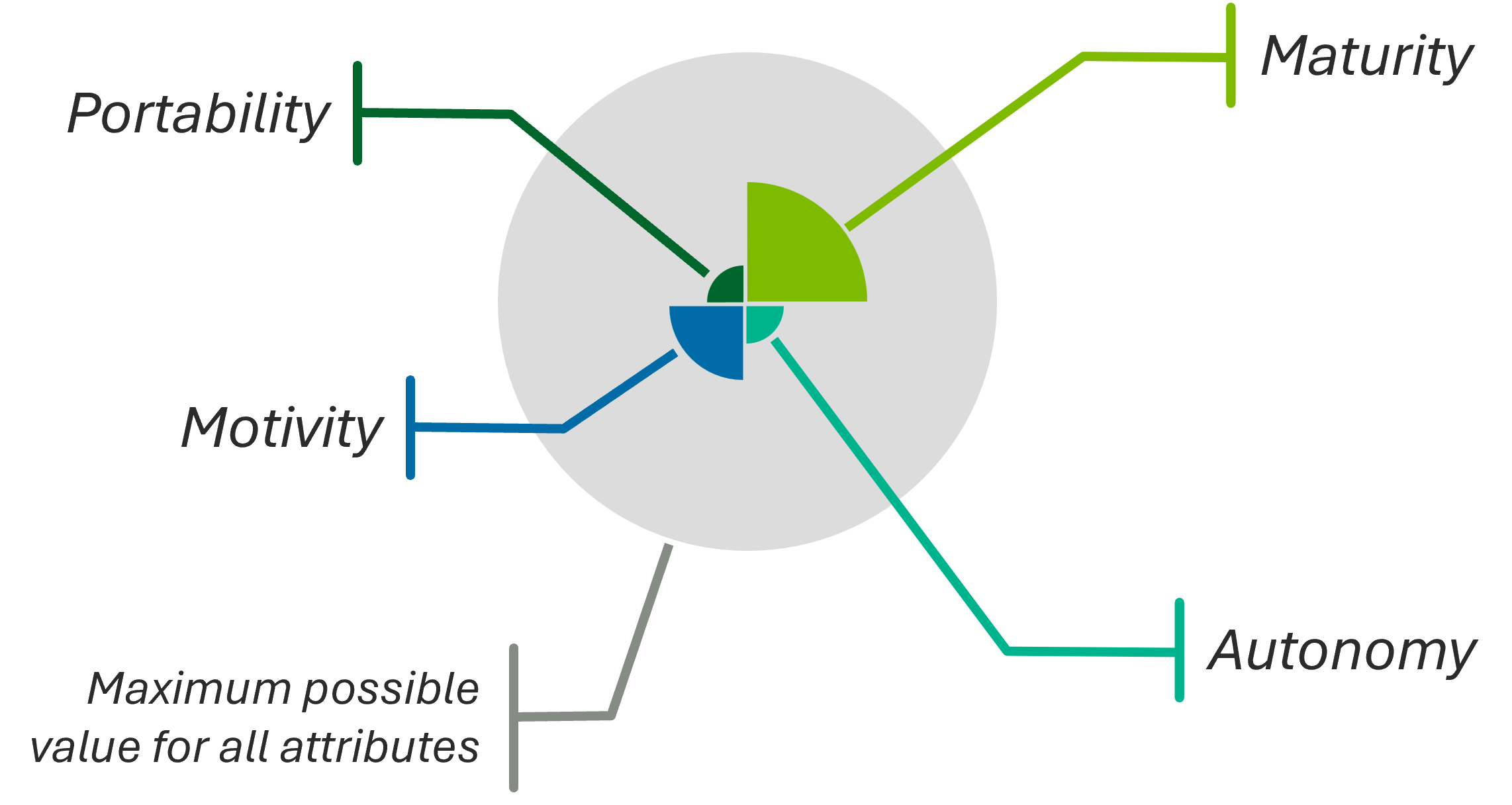
Annotated ASPECT badge